Start a conversation today with a non-Christian and you may notice quite a bit of difficulty in maintaining a rational discussion. Today’s American culture is becoming much less familiar with the Christian story. Our country is becoming more biblically illiterate making evangelism a much longer more difficult endeavor. Many in our society don’t know who Jesus Christ is or what the cross represents. The number of people claiming to not believe in a God at all is on the rise. And increasingly, several dialogues may leave your head spinning or pounding as you try to understand the postmodern mindset that says you can’t know what is true or that all beliefs are true.
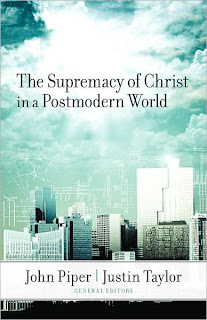
In The Supremacy of Christ in a Postmodern World, seven essays are compiled by John Piper and Justin Taylor explaining how we must engage this postmodernism with the truth of Christ. The authors who contributed to the book include: David Wells, Voddie Baucham Jr., D.A. Carson, Tim Keller, Mark Driscoll, Justin Taylor, and John Piper. Each author biblically expounds on the importance of truth, joy, love, the gospel, and the church in relation to this increasingly postmodern world. Justin Taylor summarizes them all in the introduction; “The church should become that for which it was created, namely, the pillar and buttress of truth, joy, and love in order to display the glory of God and the supremacy of Christ in all things.” (pg. 14)
David Wells begins the book with a chapter calling for defending the truth of the Christian faith. Our culture is increasingly becoming pluralistic, seeing little difference in religions. The church has been unable to offer anything of deep meaning to the culture. It has tried to accommodate other religions to the point of offering simple life enhancement and appearing to be no different from the rest. We must strive to hold to truth, declaring the counter message that Christ is the only way. Instead of pandering to the culture’s ideas, we are to offer a message that contradicts the world’s ideas. “Is the evangelical church faithful enough to explode the worldview of this new spiritual search? Is it brave enough to contradict what has wide cultural approval? The final verdict may not be in, but it seems quite apparent that while the culture is burning, the evangelical church is fiddling precisely because it has decided it must be so like the culture to be successful.” (pg. 38)
In the chapter on Truth and The Supremacy of Christ in a Postmodern World, Voddie Baucham Jr. dissects the truth of the Bible in answering four basic questions of life: who am I, why am I here, what is wrong with the world and how can what is wrong be made right? He answers these in full detail by explaining that we are the beautiful creation of God; that we were made to give glory to Him; the thing that is wrong with the world is you and me through sin; nothing we can do can make it right, but Christ made it right by taking the punishment on the cross for us. “[According to postmodern secular humanism] the solution to our woes is more education and more government. That’s the only answer our culture can propose: teach people more stuff and give them more information…If you take a sinful, murderous human being and educate that individual, here merely becomes more sophisticated in his ability to destroy.” (pg. 57) Our only hope in the world is to throw ourselves at the mercy of God and trust in Christ for righteousness.
John Piper continues the theme of his entire ministry writing about joy in The Supremacy of Christ. He gives the condensed version of the chapter by saying, “(1) Jesus’ greatest joy is in the glory of his Father, and (2) he shares this joy with us by means of understandable propositions (or Bible doctrine) about himself and his Father and his work, which the Holy Spirit illumines and ignites as the kindling of our passion for Christ.” (pg. 72) Piper explains it as we are being made to be more like Christ, our greatest joy also becomes that of Him; giving glory to the Father. By revealing Himself through the Bible, he gives us an opportunity to know Him more and through that knowledge we find more joy in His infinite glory. “If you say, ‘My joy is in the journey toward knowing, not the arrival,’ you make an idol out of the journey and you turn heaven into a disappointment…If you get most of your joy from what you don’t know about God, God is not glorified in your joy. His Son and his Book and his world are the revelation of his glory. He has made the knowledge of himself possible…Therefore, the joy you have in what you know of God is intensified by the expectation that there is so much more to see. The mystery of what you don’t know gets its God-glorifying power from what you do know. God is not glorified by strong feelings of wonder that flow from ignorance of what he is like.” (pgs. 80-81)
Especially in our culture the word “love” is very misunderstood. We say so often the promise of John 3:16 and because of the misuse of the word we often miss the depth of God’s love. D.A. Carson discusses God’s love for us (and how we are to relate it to the lost world) by first meditating on the love within the Trinity. “All of this manifestation of glory, of the goodness of God, is displayed because the Father loved Jesus before the creation of the world. The thought is stunning. All this display of the glory of God focuses finally on the goodness of God in the cross and vindication of the Son for the sake of poor sinners – and al of it is grounded in the sheer love of the Father for the Son – the same love, Jesus insists, that the Father has for us.” (pg. 94) What an amazing thought that the all-sufficient Creator of the universe who was supremely satisfied with the love He shared within the Trinity, decided to create us humans to pour out even more of His love!
Tim Keller, in the chapter focusing on the gospel itself and how we must share it with the world, stressed the importance of being very clear in our presentations. The old ways of programmed, scripted evangelism don’t work anymore because of the biblical illiteracy of our country. We were a country founded on Christian principles and shaped by biblical themes. However, many people today on the street have never heard the Christian story or are completely ignorant of any biblical references. Keller explains that we must start our evangelism farther back at the existence of God and the creation of the universe far before we can walk someone through the Romans Road. “The problem with virtually all modern evangelism programs is that they assume listeners come from a Christianized background, and so they very lightly summarize the gospel and go right to [personal commitment]. But this is no longer sufficient.” (pg. 115) We must be complete in our gospel proclamations; not just declaring salvation from sins, but also giving hope of the restoration of all things. People recognize that something is wrong with the world, and we can give them hope of a new creation.
The final chapter is written by Mark Driscoll who challenges the church to stand for truth and be an example of Christ in the world. “Jesus is as popular, controversial, and misunderstood as ever. Therefore, it is imperative that Christians contend for a faithful and biblical Christology and contextualize that Christology for a fruitful and cultural missiology.” (pg. 127) There are a lot of popular “Christs” in the world today, but it is important for us to be clear which is the true Jesus revealed to us in the Bible. Many today focus on the humble incarnation of Christ and forget that He is the reigning King of kings who will return in flaming glory to pour out His wrath on sinners. We are commissioned to tell the world of His patience and loving-kindness that is displayed until the time He returns. Driscoll, however, reminds us that while we have been given this authority to proclaim the gospel message to the world, it is Christ who is in charge and we are simply to be an example of the humble Jesus who proclaimed the good news and sacrificed his life for those He loved. Similar to Keller’s essay, Driscoll says, “Sadly, too often the church is filled with language, customs, and styles that are so altogether foreign to the average lost person that unless contextualization occurs and explanation is given, lost people will remain, in Paul’s words, ‘foreigners’ and not friends.” (pg. 144)
The entire book presents concepts that are important for every faithful Christian to understand. As missionaries in our own sub-cultures we cannot assume a changing culture will understand and embrace our unchanging message. But, we must stand for truth while we live humble lives expressing joy in God and love for others that gives us an opportunity to explain the complete gospel to a world that misunderstands the message of Christ.


